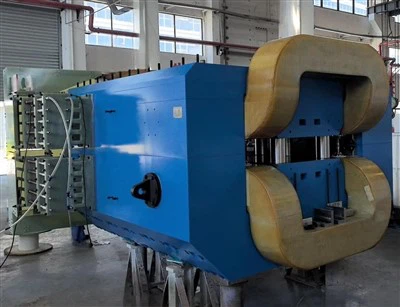
Custom electromagnets are critical for tailoring particle accelerator performance to specific experimental or industrial requirements. Their design integrates advanced magnetic field control, material science, and precision engineering to optimize beam dynamics and operational efficiency. The customization involves wide range of design consideration including magnetic field uniformity, material selection, aperture optimization and structural innovations.
Project Case:
Cutting magnet
Cutting magnet, also called beam-cutting magnet is a critical component in particle accelerators, enabling precise beam splitting, steering, and diagnostics through advanced magnetic field control. Its applications cover a wide range of scenarios, from basic physics research (such as high-energy collision experiments) to medical and industrial fields (such as proton therapy and material irradiation).

Medical and Industrial Applications
1. Proton therapy, steer proton beams to irradiate tumors with millimeter precision, minimizing damage to healthy tissues.
2. Material irradiation, direct ion beams for material modification (e.g., hardening surfaces, testing radiation resistance).
3. Non-Destructive Testing, neutron beams guided by cutting magnets analyze internal structures of aerospace components or cultural artifacts.
Fundamental Physics
1. High-Energy collision experiments, cutting magnets direct neutron beams to target materials, enabling studies of atomic structures and nuclear reactions.
2. Accelerators such as the Large Hadron Collider (LHC) rely on cutting magnets to isolate collision products for analysis.
Model Nr. Fab-40-751
√ Air gap 40mm
√ Field strength 0.751T
√ Size: 966 x 729 x 385mm
√ Weight: 440Kg

Switch Magnet
Switch magnet, also called kicker magnet, is a critical component in particle accelerators, enabling dynamic beam distribution through rapid magnetic field switching (μs-scale response). It coordinates with cutting and deflection magnets to manage beam routing, emergency shutdowns, and energy selection, forming the "traffic hub" of beam transport systems and it is the core device for dynamic beam distribution in particle accelerators.
Feature
1. Multi-Endpoint Time-Sharing
Switch magnets redirect beams to multiple experimental stations or irradiation targets sequentially, maximizing accelerator utilization in facilities like synchrotron light sources and medical proton therapy centers.
2. Emergency Beam Dumping
Instant magnetic field termination (<1 μs) isolates faulty beamlines, preventing equipment damage in high-power accelerators.
3. Energy Selection
Adjustable magnetic fields filter particles by momentum, enabling precise energy tuning for applications like industrial material testing or radioisotope production.
Applications
√ Oncology, used for multi-room proton therapy systems, allowing a single accelerator to serve multiple treatment stations.
√ Radiation processing, direct electron or ion beams to industrial targets (e.g., polymer cross-linking or food sterilization) with sub millisecond timing precision.
√ Nuclear research, manage beam distribution in accelerator-driven subcritical reactors (ADS) for nuclear waste transmutation.
Model Nr.: FAB 34-155
√ Air gap 34mm
√ Field strength 1.55T
√ Size: 1,300 x 772 x 733
√ Weight: 2,094kg

Deflection Magnet
Deflection magnet, called called bending magnet, is an essential component in particle accelerators, enabling precise control over charged particle trajectories and beam quality optimization. Their operations synergize with other magnetic elements (e.g., quadrupoles, kicker magnets) to fulfill critical roles in scientific and industrial applications.
Features & Function
1. Steering Circular Beam Paths
Deflection magnets generate uniform dipole magnetic fields to bend charged particles (e.g., electrons, protons) along circular or spiral paths, maintaining stable acceleration orbits in synchrotrons and storage rings. In medical linear accelerators, deflection magnets correct electron beam trajectories disrupted by fringe magnetic fields from bending magnets, ensuring accurate radiation targeting3.
2. Momentum Selection and Analysis
Particles with differing momenta follow distinct curvatures under a fixed magnetic field, allowing momentum filtering for experiments requiring energy-resolved beams. Relativistic effects, such as perihelion precession in gravitational fields, analogously inform momentum-dependent beam adjustments in high-energy accelerators.
3. Synchrotron Radiation Generation
High-energy electrons radiating photons when deflected by strong magnetic fields enable synchrotron light sources, widely used in material science and astrophysics research.
4. Collaborative Beam Optimization
Combined with quadrupole magnets (focusing) and kicker magnets (dynamic steering), deflection magnets mitigate beam dispersion and enhance coherence in applications like Monte Carlo-simulated radiotherapy and particle detector calibration.
Model Nr.:FAB 40-995
√ Air gap 40mm
√ Field strength: 0.995T.
√ Size: 897 x 754 x 583mm
√ Weight: 1,012Kg

Professional Project Management
Custom electromagnets are very demanding products which require special field of expertise, and we specialize in custom electromagnets designed and produced as per customers' requirements. Whenever a special size, magnetic field or force, higher heat resistance is required, Fabmann can help you design and manufacture according to your requirements. Customization really requires quite comprehensive parameters:
√ Power & holding force including heat affects
√ Force over gap (between electromagnet and ferromagnetic work piece)
√ Impact on work surfaces
√ Heat & environmental management, ohmic heating because of the resistance of the windings
√ Special dimension to match customer's application
√ Precise field, special magnetic curve
√ Materials
Hot Tags: custom electromagnet, China custom electromagnet manufacturers, suppliers, factory, electromagnet for industrial use, electromagnet for toys, electromagnet for fitness tracker devices, electromagnet for indoor use, electromagnet for magnetic presses, electromagnet for loosening tools