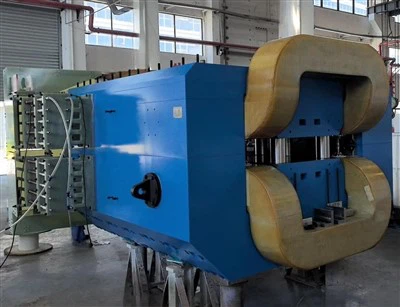
Quadrupole magnets is designed based on the basic principle that electric current generates magnetic field through coils. The main function of quadrupole magnet is to generate a transverse magnetic field to control the transverse movement of particles in the accelerator. That's why quadrupole magnets are placed at various key positions in the large hadron collider (LHC), and also because it's relatively easy to control particle beam by adjusting the field strength and distribution of the quadrupole magnet. However, the manufacturing and debugging process of quadrupole magnets is relatively complex and requires precise design and manufacturing process control.
Main Function & Advantage
Quadrupole magnets play an important role in various fields, particularly in particle physics and accelerator technology. The functionality of quadrupole magnets are listed below:
- √ Focusing particle beams for linear accelerators, it ensures that the particles remain tightly grouped and do not diverge as they gain energy.
- √ Maintaining particle beam shape for storage ring, this allows for precise control of the particle trajectories and facilitates efficient collisions for experiments.
- √ Transport the focused beam of particles to the experimental area, and prevent it from spreading or losing its shape during transportation.
- √ Beam steering, used for steering the particle beam in a desired direction by adjusting the magnetic field strength and orientation. This allows for precise control of the beam path and enables its manipulation for various experimental setups.
- √ Beam shaping, it can create beams with specific cross-sectional shapes, and it is crucial for certain experiments that require specific beam characteristics for optimal results.

Quadrupole magnets can be used to compress the size of particle beams. In the accelerator, the size of the particle beam will continue to expand as the acceleration process progresses, which will have an adverse effect on the focusing and collision of particles. To solve this problem, the quadrupole magnets in the LHC are used to focus the particle beam and compress it to the required size range. By adjusting the magnetic field strength and distribution of the quadrupole magnets, the particle beam can be kept tight, thereby improving the focusing effect and collision probability of the particles. The quadrupole magnet can also precisely bend and focus the particles by adjusting the strength and distribution of the magnetic field, so that the particles can stay in the designed orbit, and that's why quadrupole manages are used for accelerators. By rationally designing the parameters and layout of the quadrupole magnet, the particle beam can be precisely controlled and optimized. They have the following advantages:
- √ Stronger focusing capability
- √ Transversely changing magnetic fields, making the particle orbit in the accelerator more stable
- √ Correct off-axis deviations
- √ Keep particles moving on the designed orbit
- √ Great flexibility, quadrupole magnets can be adjusted and optimized to meet the acceleration and focusing.
- √ The structure of the concentric magnetic field is relatively fixed.
Application
Quadrupole magnets are essential tools in various fields, enabling precise control and manipulation of charged particle beams. Their applications range from focusing and steering beams in particle accelerators to separating ions in mass spectrometers and generating magnetic fields for medical imaging. Below is their application:
- √ Nuclear magnetic resonance (NMR), it is used in NMR spectrometers to generate the magnetic field gradients necessary for manipulating the nuclear spins of atoms. This enables the study of the structure and dynamics of molecules.
- √ Medical imaging, it is applied in some magnetic resonance imaging (MRI) scanners to create the strong magnetic field needed for generating detailed images of the human body.
- √ Mass spectrometry, it is used for separating ions based on their mass-to-charge ratio, and this allows for the identification and quantification of different molecules in a sample.
Concept and design is very powerful if it's backed up by solid experience, our in-house design team is highly integrated with both production team and lab testing, and our team has solid experience in validating your magnet models before making quotation. Due to this special capacity, we can make current choice for you regarding manufacturability, efficiency and repeatability, from the first stages of design to finished products. Fabmann works with various top notch materials to develop customized quadrupole magnets, and our engineers and designers can create solutions tailored to your specific application needs. Our product engineering team will make careful analysis of your application demand, and then select the appropriate materials, fabrication techniques, assembly solution and validation testing process for achieving superior performance, efficiency, and reliability compared to off-the-shelf options. Our mission is to deliver high precision customized quadrupole magnets for demanding applications where precise control and optimized performance are critical.
Our Models
Model Nr.: FAB54-21T
Core Material: Silicon Steel
Air Gap: Ф54
Overall Dimension: 534 x 430 x 600mm
Weight: 500kg
Field Strength: 21T/m

Model Nr.: FAB120-63T
Core Material:Electrical Pure Iron DT4
Overall Size:922 x 250 x 860mm
Air Gap: Ф120
Weight:496.5kg
Field Strength:6.3T/m

Model Nr.: FAB40-15T
Core Material: Electrical Pure Iron DT4
Overall Size: 460 x 277 x 499mm
Air Gap: Ф40
Weight:230.5kg
Field Strength:15T/m

Hot Tags: quadrupole magnet, China quadrupole magnet manufacturers, suppliers, factory, electromagnet for corrosive environments, electromagnet for milling tools, electromagnet for polishing tools, electromagnet with explosion proof function, electromagnet for networking equipment, electromagnet for gaming equipment