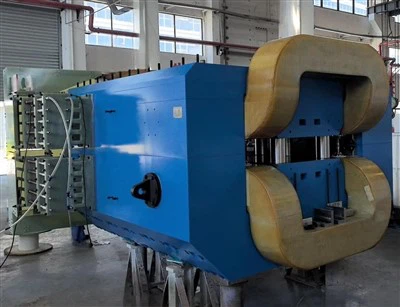
As an important form of magnet, the solenoid magnet is widely used in various fields. The magnetic induction intensity of the solenoid can be calculated by the formula B=μ0NI/L, where B is the magnetic induction intensity, μ0 is the vacuum permeability, N is the number of coil turns per unit length of the solenoid, I is the excitation current of the coil, and L is the length of the solenoid. This formula helps us calculate the magnetic induction intensity of the solenoid under specific conditions. The magnetic induction intensity of the solenoid is also affected by other factors. For example, the diameter and length ratio of the solenoid (D/L) will affect the distribution of the magnetic induction intensity. In short, a solenoid is a type of electromagnet, the purpose of which is to generate a controlled magnetic field through a coil wound into a tightly packed helix.
Difference Between Solenoids and Electromagnets
Electromagnets are temporary magnets, and magnetic field are generated by electric currents. The electromagnets consist of large number of coils with a core inside the coil, for instance like solenoids, the main function of adding a core and increasing the number of turns is to increase the strength of the magnetic field.
Whereas solenoids are cylindrical coils of wire consisting of many loops that act as electromagnets when current passes through them. Electromagnets are electrically induced magnets, and solenoids are cylindrical coils of wire acting as magnets when carrying electric currents.
The main function of solenoids is to provide a perfect uniform magnetic field similar to what is produced by a permanent magnet. Since it's dependent on electric current, it can be turned on or off as needed, and therefore its versatility leads to a wide range of applications. The strength of the field increases as the number of loops or coils increases, and the magnetized ferromagnetic material inside the solenoid adds to the strength of the magnetic field produced by the current alone.
How does a solenoid electromagnet work?
When a current passes through the solenoid electromagnet, a magnetic field is generated around the solenoid, and the direction of the magnetic field can be found with the help of right-hand grip rule. The direction of magnetic field is decided by the direction of the current in the solenoid, and the field generated by solenoid electromagnet is uniform and strong. The essence of the solenoid magnet is an electromagnet, and its basic principle is Ampere's law, the magnetic field formed by the wire is applicable to the current regardless of whether there is a coil or a solenoid. When an electric current passes through the coil, the solenoid electromagnet produces a magnetic field and converts that magnetic energy into mechanical motion. By increasing the flow of electric current or increasing the density of the turns, the magnetic strength of the solenoid can be increased. Therefore, a solenoid electromagnet can convert electrical energy into mechanical work through electromagnetic forces.
Application
Solenoid electromagnets have the advantages of generating a strong magnetic field, which is stable and easy to control, and therefore it has a very wide applications such as:
- √ Medical field, such as MRI (magnetic resonance imaging technology), MRS (magnetic resonance spectroscopy technology), MRT (magnetic resonance hemodynamics technology), and it's used to examine the internal structure and physiological functions of the human body. For instance, it is used in the low energy beam transfer line of the Cancer Therapy Facility.
- √ Linear accelerators (often superconducting), and magnets for particle tracking in experiments (normal or super conducting).
- √ Aviation industry, it is used for changing and coordinate the flight direction.
- √ Metallurgy industry, it can be used for surface hardening, bending, straightening, heating, etc. of steel billets. It is used in the production line of steel plants to improve the processing efficiency of steel billets and reduce production costs.
Design Consideration
Design and concept decide the functionality and cost of manufacturing, and our in-house design team is highly integrated with both production team and lab testing. Our team has solid experience in validating your models before making offer. Due to this advantage, we can optimize production solution for you regarding manufacturability, efficiency and repeatability, from the first stages of design to finished products. Fabmann works with various top notch material suppliers to develop customized electromagnet, and our engineers and designers can create solutions tailored to your specific application needs. The design is driven by the application, and therefore, all aspects shall be taken into consideration, and our engineering team focuses on the following aspects for solenoid electromagnet:
- √ Small air gap is important for optimum pull-strength
- √ Larger solenoids generate stronger pulling forces with less power than smaller solenoids.
- √ Significant power savings can be achieved when the plunger has completed its travel.
- √ A lever linkage can be used on a solenoid to efficiently gain extra pull force at distance.
- √ More expensive materials can give considerably improved performance
- √ The relative amounts of copper to iron can be adjusted to yield a significantly optimum force per unit power.
- √ Maximum force could be achieved with the gap at the stationary end of the solenoid, although reduced plunger mass may be a better trade-off.
Our Custom Model
Model Nr.: FAB1200-276
PWI magnet coil assembly,
OD: 1738mm,
ID: 1200mm,
Width: 208mm,
Number of turns: 276,
Current density: 2.082A/mm2

Model Nr.: FAB600-550
Number of magnets:8 Solenoid aperture (mm): 600
Axial magnetic field (Gs): 3000 Axial range of good field (mm): 500-3350
Uniformity of good field: 2% Ampere-turns (AT): 89100
Number of turns per pole: 162 Maximum excitation current (A): 550
Hollow conductor: 12 x 12 Ф9 Maximum current density (A/mm²): 6.95
Coil resistance: 0.11 Coil voltage drop (V): 60
Maximum power consumption (KW): 33 Solenoid axial length: 80mm
Solenoid inner diameter/outer diameter: 600/1300 Total magnet weight: 350kg
Water pressure drop (kg/cm²): 4 Number of water paths: 6
Water flow rate (m/s): 1.78 Water flow rate (L/s): 0.68
Coil temperature rise (C°): 13

Model Nr.: FAB90-285
OD: 378mm,
ID: 60mm,
Width: 180mm,
Number of turns: 18
Field strength: 0.285T
Weight: 130Kg

Hot Tags: solenoid electromagnet, China solenoid electromagnet manufacturers, suppliers, factory, small electromagnet, Quadrupole Magnet, electromagnet for educational equipment, electromagnet with long service life, electromagnet factory, lifting electromagnet