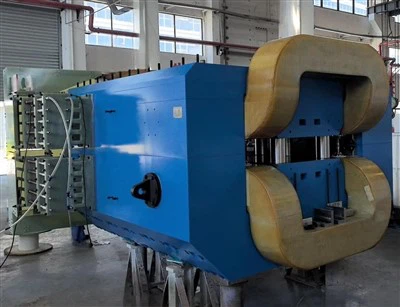
Corrector magnets are essential components in systems involving charged particle beams, ensuring that the beam remains accurately aligned and on its intended path, and they play a critical role in maintaining the performance and precision of particle accelerators, beamlines, and other applications.
Why corrector magnets are needed?
Corrector magnets are critical for maintaining the precision and stability of charged particle beams in complex systems. They compensate for errors, imperfections, and external disturbances, ensuring the beam follows the intended trajectory and meets the requirements of the application. Without corrector magnets, even small deviations could lead to significant performance issues or failures in systems like particle accelerators, beamlines, and medical therapy devices. That's why they are needed to address and compensate for various errors and imperfections that can cause deviations in the beam's trajectory. They server the following purposes:
- √ Imperfections in Magnetic Fields
The main guiding magnets (e.g., dipole and quadrupole magnets) in a beamline or accelerator are designed to steer and focus the beam. However, these magnets may have small imperfections in their magnetic fields, leading to slight deviations in the beam's path. Therefore, corrector magnets are required to compensate for these imperfections and ensure the beam follows the desired trajectory.
- √ Misalignments of Components
Beamline components, such as magnets, vacuum chambers, and diagnostic devices, may not be perfectly aligned due to manufacturing tolerances or installation errors. Corrector magnets can adjust the beam's position and angle to compensate for these misalignments.
- √ Beam Instabilities
Charged particle beams can experience instabilities due to external disturbances, such as vibrations, thermal effects, or electromagnetic interference. Corrector magnets are used to dynamically stabilize the beam and keep it on the correct path.
- √ Optical Aberrations
In complex beamlines, the beam optics may introduce aberrations (e.g., deviations from the ideal path) due to nonlinear effects or mismatched focusing.
Corrector magnets help correct these aberrations to maintain beam quality and focus.
- √ Beam Steering Errors
In applications like particle accelerators or medical proton therapy, precise steering of the beam is critical. Even small errors in beam direction can lead to significant deviations over long distances. Corrector magnets are used to fine-tune the beam's direction and ensure it reaches the intended target.
- √ Beam Position Monitoring and Feedback
Beam position monitors (BPMs) are used to measure the beam's position in real-time. If deviations are detected, corrector magnets can be activated to bring the beam back to the desired position, and this feedback loop is essential for maintaining beam stability in high-precision systems.
- √ Compensating for External Factors
External factors, such as Earth's magnetic field, temperature changes, or mechanical vibrations, can affect the beam's trajectory. Corrector magnets are used to counteract these effects and keep the beam aligned.
- √ Maintaining Beam Quality
In applications like free-electron lasers (FELs) or synchrotron radiation sources, beam quality (e.g., position, angle, and focus) directly impacts performance. Corrector magnets ensure the beam meets the required specifications for optimal operation.
- √ Dynamic Adjustments
In some systems, the beam's path may need to be adjusted dynamically during operation. For example, in medical proton therapy, the beam must be precisely scanned across a tumor. Corrector magnets enable real-time adjustments to achieve the desired beam distribution.
Design Feature
Scanning magnets have certain features as follows:
- √ Electromagnetic coils generate a magnetic field when an electric current is passed through the coils.
- √ Precision control, the strength and direction of the magnetic field can be finely tuned to make small corrections to the beam's trajectory.
- √ Compact design, it's typically smaller and less powerful than the main guiding magnets (e.g., dipole or quadrupole magnets) in the system.
- √ Multiple axes, corrector magnets can adjust the beam in both horizontal and vertical directions, depending on the design.
Project Case
Model Nr.: FAB6-500
- Material: Electrical pure iron DT4
- Size: 212*80*190mm
- Air gap: 80mm
- Magnet weight: 6kg
- Magnetic field: 500Gs

Model Nr.: FAB155-26
- Material: Electrical pure iron DT4
- Size: 271*99*297.1mm
- Air gap: 120mm
- Magnet weight: 15.5kg
- Magnetic field: 26.62Gs

Model Nr.: FAB155-195
- Material: Electrical pure iron DT4
- Size: 525*442*463mm
- Air gap: 110mm
- Magnet weight: 15.5kg
- Magnetic field: 195Gs

Hot Tags: corrector magnet, China corrector magnet manufacturers, suppliers, factory, electromagnet for educational equipment, electromagnet manufacturer, electromagnet for virtual reality equipment, electromagnet for switches, Custom Electromagnet, electromagnet for telecom equipment